
Wildfire Season: How to Protect Exposed Commercial Buildings During Repairs and Rebuilding
Wildfire Season: How to Protect Exposed Commercial Buildings During Repairs and Rebuilding
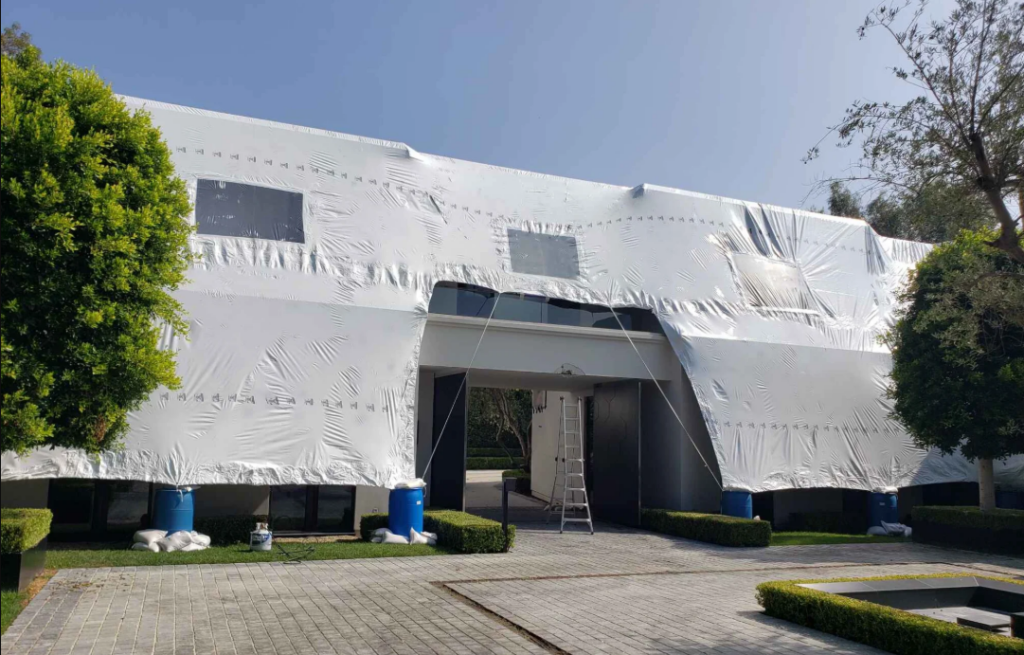
When a wildfire damages a commercial building, extinguishing the fire does not necessarily end the property’s exposure.
Parts of the structure may remain open to weather and other environmental conditions while owners, contractors, engineers, insurance professionals, and restoration teams determine what can be saved and what needs to be rebuilt.
For a commercial property, that period between the initial damage and permanent reconstruction can become a project of its own.
Temporary protection can help shield appropriate areas while inspections, cleanup, demolition, and rebuilding move forward. The key is designing that protection around the condition of the building, the work that still needs to happen, and the realistic recovery timeline.
Fire Damage Can Leave a Building Exposed Long After the Emergency Ends
The first priority after a fire is addressing the immediate emergency and determining when the property can be safely accessed.
Once that process moves into recovery, however, the building may still have significant openings.
Damaged roofing can allow rain into areas that survived the fire. Missing windows or exterior walls can leave interiors exposed to wind and airborne debris. Equipment or materials that remain inside may also need protection while decisions are made about removal, repair, or reuse.
That means the recovery team has to think beyond what the fire damaged.
It also has to consider what could be damaged next if the property remains exposed.
For larger commercial, industrial, and institutional properties, temporary roofs, walls, or other enclosures may provide protection during that vulnerable period while permanent work is being planned.
Plan Temporary Protection Around the Full Recovery Timeline
A commercial building damaged during dry weather may remain under repair long enough to encounter entirely different conditions.
That matters in Southern California, where a property damaged during wildfire season could still have an unfinished roof, open walls, or exposed materials when seasonal rain arrives.
The recovery schedule can also change.
Engineering evaluations, damage documentation, cleanup, demolition, permitting, insurance coordination, and trade scheduling can all affect when permanent reconstruction begins.
A portion of the building expected to remain open for two weeks could remain exposed much longer.
At Shrink Wrap Pros, we approach temporary protection with that broader timeline in mind. The enclosure should account for how long protection may be needed, what conditions the property could encounter during that period, and what work must continue while the system is in place.
Ash and Fire Debris Require Special Handling
Post-fire work can involve more than protecting a building from rain.
Wildfire ash and debris can create health, environmental, and remediation concerns. Burned structures can contain materials that require specialized handling, and access to damaged areas may be restricted until the appropriate authorities or qualified professionals determine that work can proceed.
Temporary enclosure planning therefore needs to be coordinated with the broader cleanup and remediation process.
Depending on the project, temporary walls or enclosures may help separate active work areas, limit environmental exposure, or support site-specific containment plans developed for the work being performed.
But shrink wrapping is not a substitute for required hazardous-material procedures, structural evaluation, environmental controls, or official cleanup requirements.
For us, the question is not simply whether an opening can be covered. It is whether a temporary enclosure can be safely integrated into the cleanup, demolition, restoration, and construction work already underway.
Large Commercial Properties Require a Project-Specific Approach
A fire-damaged warehouse presents a different problem from an exposed office building, institutional property, manufacturing facility, or large multifamily structure.
A warehouse may have a substantial roof opening.
A manufacturing property may contain machinery that cannot immediately be relocated.
A larger building may have several exposed elevations.
Scaffolding may already be in place for demolition or reconstruction.
Multiple contractors, inspectors, engineers, and restoration professionals may need access throughout the day.
Those variables affect how temporary protection should be designed.
Before we develop an enclosure, we look at factors such as:
- Which portions of the building remain exposed
- Whether a temporary roof, wall, or scaffold enclosure is appropriate
- Whether the supporting scaffold or temporary framework is suitable for the loads created by the enclosure and anticipated wind conditions
- What equipment or materials remain inside
- How crews will access protected areas
- What inspection, cleanup, demolition, or reconstruction work must continue while the enclosure is in place?
The goal is not simply to cover the largest possible area. It is to develop temporary protection that works with the recovery plan.
Temporary Roofs Can Bridge the Gap Before Permanent Repairs
Roof damage is often one of the most immediate exposure concerns after a major fire.
Traditional tarps can be useful for certain short-term situations, but larger openings or longer recovery periods may call for a different approach.
For appropriate projects, shrink-wrap film can be installed over a suitable supporting system and heat-sealed to create a tight temporary roof or enclosure around the exposed area.
That does not make the system a replacement for permanent roofing.
Its purpose is to provide temporary environmental protection while permanent repairs are evaluated, scheduled, and completed.
Do Not Overlook Equipment and Materials That Survived the Fire
The building itself may not be the only valuable asset at risk.
Commercial and industrial properties can contain manufacturing machinery, HVAC components, electrical equipment, inventory, building materials, tools, and other assets that remain salvageable even when part of the structure has been damaged.
If those items cannot be removed immediately, they may require their own protection.
A building enclosure can address exposure across a larger area, while individual equipment or components may need more targeted protection depending on their condition, location, ventilation or moisture-control needs, and whether they are awaiting inspection, restoration, or removal.
This becomes particularly relevant when equipment is:
- Expensive or difficult to replace
- Subject to long manufacturing lead times
- Vulnerable to moisture or corrosion
- Waiting to be removed, relocated, or evaluated
- Needed during reconstruction
- Too large to move easily
Thinking separately about the structure and the assets inside it helps prevent a recovery plan from protecting the building envelope while leaving critical equipment unnecessarily exposed.
Access Has to Be Designed Into the Enclosure
A damaged commercial property rarely sits untouched while repairs are coordinated.
Engineers may return for inspections.
Insurance professionals may need access.
Restoration contractors may be working inside.
Demolition crews may need to remove damaged materials.
Construction trades may begin rebuilding one part of the property while another area remains temporarily enclosed.
That means access cannot be treated as an afterthought.
Where appropriate, we can incorporate zipper doors or other planned access points into shrink-wrap enclosures so crews can enter protected areas without repeatedly cutting through and patching the material.
For larger projects, we also consider where those openings should be located based on how people, materials, and equipment will move through the site.
A temporary enclosure should support the work taking place inside it, not become another obstacle for the recovery team.
Complex Disaster-Recovery Projects Require Coordination
Large post-fire projects can involve owners, general contractors, restoration companies, engineers, insurance representatives, environmental professionals, scaffolding contractors, and multiple construction trades.
The property itself may also present unusual dimensions, exposed areas, access limitations, or equipment that has to remain in place.
That is why flexibility matters.
At Shrink Wrap Pros, we work with the teams responsible for larger construction, commercial, industrial, and disaster-recovery projects to develop temporary protection around the conditions they are actually dealing with.
For large or specialized projects, our mobile crews can also travel beyond Southern California when the scope warrants nationwide deployment.
The objective is to fit the enclosure into the recovery effort, not force the recovery effort to work around a generic covering system.
Protect What Remains While the Next Phase Is Planned
Recovering from a major fire takes time.
Permanent rebuilding should be based on proper evaluation, cleanup, engineering, and construction planning. But the time required to complete those steps does not mean salvageable structures, equipment, and materials should remain unnecessarily exposed.
Temporary protection can help bridge the period while cleanup, engineering, remediation, and permanent reconstruction move forward.
It does not replace those specialized services. Its role is to protect appropriate areas and assets while the larger recovery effort continues.
If you are responsible for a fire-damaged commercial property, industrial facility, construction site, or other large exposed structure, contact Shrink Wrap Pros early in the recovery process. We can discuss the exposed areas, project timeline, access requirements, remaining assets, site conditions, and work ahead to determine what type of temporary protection may be appropriate.
Disclaimer: This article is for general informational purposes only. Every property and project is different, and the right temporary protection depends on the condition of the structure, site conditions, access needs, and the work being performed.